Jim Rogers Commodity Investing Journey Across Global Financial Markets
Have you ever looked at the global financial landscape and wondered how some people manage to spot massive market shifts years before everyone else? It’s easy to feel overwhelmed, but unpacking the legendary Jim Rogers Commodity Investing Journey reveals a ground-breaking framework that shifted how generations of investors look at real, physical assets. Learning how to spot these long-term wealth trends isn’t much different from mastering other cooperative financial goals in life, such as understanding budgeting for couples: how to merge finance without the friction – both require patience, open communication with the data, and looking at the big picture.
Rather than hiding behind Wall Street desks, Rogers combined a deep passion for history with world-record-breaking travel, proving that the best investment insights are often found on the open road. By studying his adventures, everyday investors can learn how to block out market noise and look at the tangible things driving our economy.
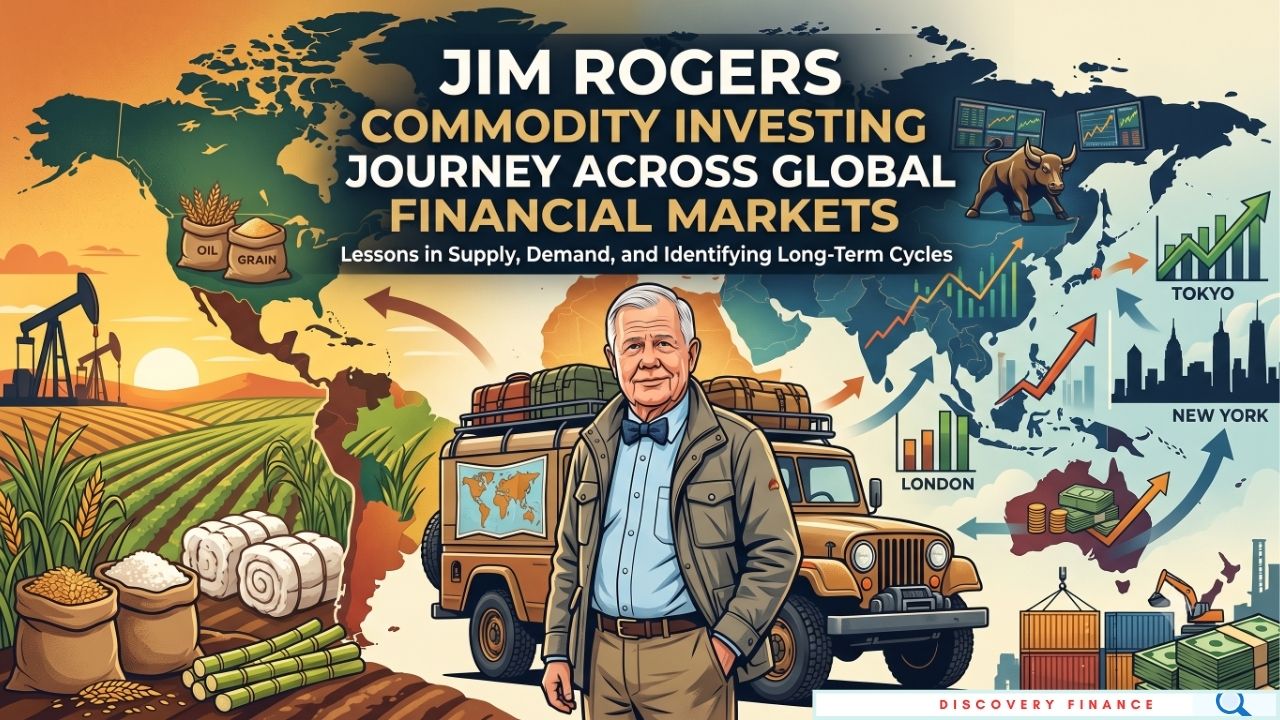
The Foundations of the Jim Rogers Commodity Investing Journey
To truly appreciate the Jim Rogers Commodity Investing Journey, we have to back to business basics: supply and demand. After co-founding the famous Quantum Fund with George Soros in the 1970s – where the duo racked up an astronomical 4,200% return compared to the S&P 500’s modest 47% – Rogers did something radical. He retired at age 37 to travel the globe on his motorcycle and in custom vehicles, examining how economies functioned from the ground up.
His travels taught him that standard stock-picking often misses the broader macro cycles. He realized that the world regularly swings between periods of paper asset booms (like technology stocks) and real asset booms (like raw materials). Much like studying the Ray Dalio economic principles that changes how investors understand markets, Rogers learned to view global markets not as isolated math problems, but as deeply repetitive historical cycles driven by human behavior and resource scarcity.
Riding the Cycles of the Jim Rogers Commodity Investing Journey
The core philosophy behind the Jim Rogers Commodity Investing Journey is that commodities are much simpler to understand than individual corporate stocks. If the world builds too many houses, the demand for timber, copper, and steel skyrockets. If no one opens new mines for a decade because prices are low, a massive supply shortage is guaranteed to happen eventually.
In 1998, noticing that raw material prices were at historic lows and that a rising China would require massive amounts of infrastructure, Rogers launched the Rogers International Commodity Index (RICI). His timing was impeccable, catching a historic multi-year bull run in energy, agriculture, and metals. His strategy emphasizes that investors should focus on what they genuinely know – the basic goods of everyday life, like corn, cotton, sugar, and crude oil.
Final Thoughts on Your Investing Path
At the end of the day, looking back at the Jim Rogers Commodity Investing Journey Across Global Financial Markets reminds us that real wealth building is a marathon, not a sprint. It teaches us to block out the daily noise of the stock market casino, look for true value where others are fearful, and stay grounded in basic economic truths.
Are you taking a top-down look at your own financial roadmap? Whether you’re exploring tangible assets or turning out short-term volatility, sharing curious and doing your homework is the ultimate key to success. Keep your head level, stay adventurous, and happy investing!
Share this:



One Comment
Pingback: