Percy Fawcett: The Lost Explorer Who Never Returned
The jungle does not announce when it keeps a secret. It simply closes in – slowly, silently – until even the bravest footsteps are swallowed whole. In 1925, Percy Fawcett walked into the Amazon rainforest convinced he was on the verge of the greatest discovery of his life. What followed was not triumph, but silence. The story of Percy Fawcett is not just about exploration; it is about obsession, faith in the unknown, and a disappearance so complete that history itself seems unsure how to explain it.
At the height of his career, Percy Fawcett was admired for his discipline, courage, and unshakable belief that the Amazon hid traces of an ancient advanced civilization – the legendary Lost City of Z. But when he vanished along with his companions, the world was left with questions that still echo today. Like other haunting mysteries – such as the unexplained vanishing explored in The Disappearance of Dorothy Arnold, case unsettles us because there is no body, no proof, and no final answer.
Over a century later, historians, explorers, and archaeologists continue to debate what truly happened to him. Reputable institutions such as the Smithsonian have revisited his journey, noting that modern discoveries suggest parts of his theory may not have been fantasy after all. Yet despite renewed interest and evidence, Percy Fawcett remains lost – somewhere between myth and reality, swallowed by the very jungle he believed would secure his legacy.
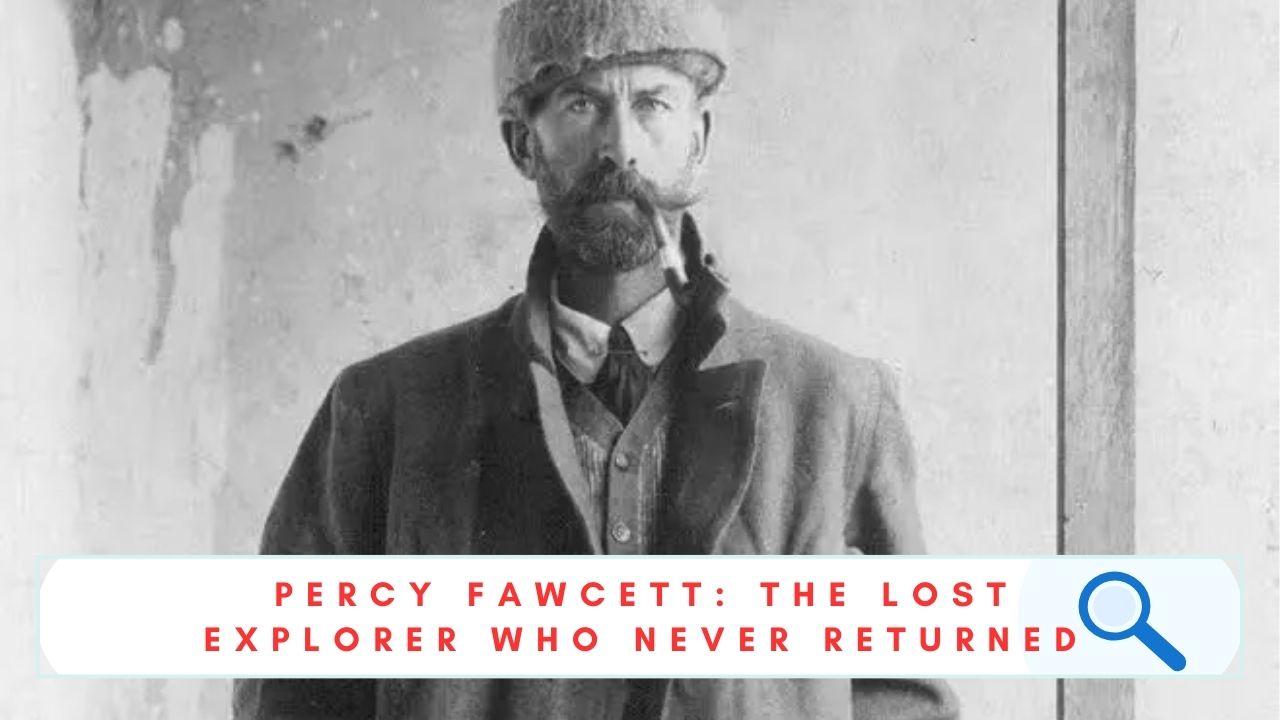
Who Was Percy Fawcett Before the Disappearance
Before the world knew his name as a mystery, Percy Fawcett was known as a man of discipline and quiet authority. Born in1867 in England, he was trained as a surveyor and soldier – skills that would later make him invaluable to the Royal Geographical Society. At a time when much of South America remained unmapped by Europeans, Fawcett was sent into some of the most dangerous and remote regions of the Amazon to chart borders and terrain.
Those early expeditions hardened him. He survived disease, starvation, hostile encounters, and weeks of isolation. Unlike many explorers of his era, Fawcett showed unusual respect for Indigenous tribes, believing cooperation – not conquest – was the key to survival. This belief allowed him to venture deeper into the jungle than most dared, but it also shaped the mindset that would later place him in unimaginable danger.
As years passed, the Amazon stopped being just a job. It became a calling. What began as professional duty slowly transformed into obsession, as scattered clues, ancient texts, and local legends convinced him that the rainforest concealed something extraordinary.
Percy Fawcett’s Belief in the Lost City of Z
Percy Fawcett was not chasing gold – he was chasing validation. He became convinced that an advanced ancient civilization once thrived deep within the Amazon, directly contradicting the popular belief that the rainforest could not support complex societies. He called this civilization the Lost City of Z.
His conviction was fueled by historical documents, including an old Portuguese manuscript describing ruined stone cities hidden in Brazil’s interior. To Fawcett, these were not myths – they were evidence. He believed discovering Z would rewrite human history and prove that the Amazon was not a primitive wasteland, but a cradle of civilization.
This belief consumed him. Critics dismissed his ideas as fantasy, but their skepticism only strengthened his resolve. For Percy Fawcett, finding Z was no longer about exploration – it was about legacy, truth, and proving that some mysteries exist not to be imagined, but to be found.
Percy Fawcett’s Final Expedition Into the Amazon
By 1925, Percy Fawcett was no longer interested in large, well-funded expeditions. Experience had taught him that the jungle punished size and noise. This time, he chose silence and simplicity. Accompanied only by his son Jack and Jack’s close friend Raleigh Rimmell, Percy Fawcett set out on what he believed would be his final journey – one that would either confirm his life’s work or end it.
The trio departed from Cuiabá, Brazil, carrying minimal supplies and an unshakable sense of purpose. Fawcett believed that a small group would attract less attention from hostile tribes and allow them to move faster through the unforgiving terrain. He was confident – almost eerily so – that they would succeed. To those who knew him, it felt less like preparation and more like farewell.
As they pushed deeper into the jungle, communication with the outside world faded. The Amazon closed around them wit its usual indifference. Each step forward reduced the chances of rescue, yet Percy Fawcett pressed on, convinced that the answers he sough lay just beyond the next river bend.
Percy Fawcett’s Last Known Location and Message
The final confirmed trace of Percy Fawcett came from a campsite he named “Dead Horse Camp”, ominously located near the upper Xingu River. From there, he sent his last known message to his wife – a calm, almost reassuring letter that offered no hint of fear.
In it, he warned others not to follow. He believed rescue missions would only lead to more deaths. The words read less like caution and more like acceptance, as if Percy Fawcett already understood the risk he was taking. After that message, there was nothing. No further letters. No sightings. No confirmed remains.
The jungle did what it has always done best – it erased the trail. What happened next would become one of the greatest unsolved mysteries in exploration history, spawning rumors, theories, and deadly rescue attempts that would stretch on for decades.
Theories Surrounding Percy Fawcett’s Disappearance
When Percy Fawcett vanished, the silence he left behind was quickly filled with speculation. With no bodies, no campsite debris, and no confirmed eyewitnesses, the mystery invited theories as wild and unforgiving as the jungle itself. Over the years, dozens of explanations have surfaced – some grounded in evidence, others born from fear, imagination, and desperation.
What makes the disappearance of Percy Fawcett so haunting is not just that he was lost, but that every possible explanation seems plausible. The Amazon offers no single answer – only fragments of truth scattered across time.
Was Percy Fawcett Killed by Hostile Tribes
One of the earliest and most widely discussed theories suggests that Percy Fawcett and his companions were killed by an Indigenous tribe after crossing into restricted territory. Some tribes were known to defend their land fiercely, especially after suffering violence or betrayal from outsiders.
Decades later, conflicting tribal accounts emerged – some claiming responsibility, others denying any contact at all. Yet no physical evidence was ever produced. Without remains or artifacts, these claims remain impossible to verify, leaving this theory suspended between possibility and myth.
Did Percy Fawcett Choose to Disappear
Another theory paints Percy Fawcett not as a victim, but as a man who willingly vanished. Some believe he abandoned civilization to live among an Indigenous tribe, escaping a world that had grown too skeptical, too small for his beliefs.
Supporters of this idea point to his increasing disillusionment with modern society and his deep respect for tribal culture. But critics argue that this theory romanticizes survival while ignoring the brutal realities of jungle life. No credible evidence has ever confirmed that Percy Fawcett lived on beyond his final expedition.
Percy Fawcett and the Amazon’s Deadly Reality
Perhaps the most sobering explanation is the simplest one: the jungle itself. Disease, starvation, venomous wildlife, and impassable terrain have claimed countless lives – many of them far less experienced than Percy Fawcett.
In this version of events, there was no dramatic confrontation, no final stand – only exhaustion, illness, and inevitability. The Amazon does not need witnesses. It does not leave clues. It absorbs.
Percy Fawcett’s Legacy and the Explorers Who Followed
The disappearance of Percy Fawcett did not end with silence – it ignited obsession. In the decades that followed, more than a dozen expeditions were launched to find him, his son, or any trace of the Lost City of Z. Ironically, many of those who went searching never returned themselves. The jungle that swallowed Percy Fawcett seemed to demand more lives in exchange for answers.
Some explorers claimed to have found bones. Others brought back artifacts later proven to be unrelated. Each supposed breakthrough collapsed under scrutiny, adding another layer of tragedy to an already haunting story. Percy Fawcett had warned the world not to follow him – but the mystery was too powerful to resist.
His influence stretched far beyond exploration. Writers, filmmakers, and historians kept his story alive, transforming him into a symbol of humanity’s relentless need to understand what lies beyond the known world. Modern archaeological discoveries, including evidence of ancient Amazonian settlements, suggest that parts of his vision may have been correct after all – a point explored in depth by institutions like the Smithsonian, which revisited his legacy in light of new findings.
Percy Fawcett and History’s Most Haunting Vanishings
What makes Percy Fawcett’s story endure is how closely it mirrors other unexplained disappearances. Like the chilling case explored in The Disappearance of Dorothy Arnold, where a young woman vanished without a trace in the heart of New York City, Fawcett’s case defies logic and resolution. Different worlds, different circumstances – yet the same unbearable absence of answers.
Both stories remind us that mystery does not belong only to remote jungles or distant eras. It can exist anywhere, at any time, leaving behind nothing but questions and the quiet ached of unfinished stories.
Why Percy Fawcett Still Captivates the World
More than a century after his disappearance, Percy Fawcett continues to haunt the imagination – not because of what we know, but because of what we never found. In an age where satellites map every corner of the planet, his story reminds us that some mysteries still resist explanation.
Recent archaeological discoveries have revealed vast, complex earthworks hidden beneath the Amazon canopy, suggesting that ancient civilizations once flourished there. These findings have renewed interest in Percy Fawcett’s theories, hinting that his belied in the Lost City of Z may not have been pure fantasy after all. Major research publications and organizations like National Geographic have explored this possibility, carefully revisiting his ideas with modern evidence.
Yet facts alone cannot explain is lasting appeal. Percy Fawcett represents something deeply human – the willingness to risk everything for a truth that only you believe in. His disappearance is not just a historical puzzle; it is a reflection of obsession, faith, and the fine line between courage and self-destruction.
Percy Fawcett Between Myth and Truth
Over time, Percy Fawcett has become more than a man – he has become a symbol. To some, he is a visionary explorer ahead of his time. To others, he is cautionary tale about obsession unchecked. The truth likely exists somewhere between those extremes.
What remains undeniable is that the Amazon never gave him back. No final proof. No closure. Just a story suspended between legend and reality. And perhaps that is why Percy Fawcett endures – because some mysteries are not meant to be solved, only remembered.
Share this:


You May Also Like

The Disappearance of Brandon Swanson: What You Need To Know 2025 Update

Socotra Travel Guide: Exploring The Island of Alien Landscapes