Thomas Gresham History and the Law That Changed Money Forever
Have you ever wondered why old coins vanish while worn-out change stays in your pocket? It all comes back to a fascinating piece of history. Thomas Gresham History reveals how a 16th-century English financier and merchant stumbled upon a rule of human behavior and currency that still rings true today. Whether we are balancing our own checking accounts or trying to navigate financial hurdles like defeating shrinkflation with strategic hacks to trim your monthly grocery budget, understanding how value works is just as crucial now as it was during the Tudor dynasty.
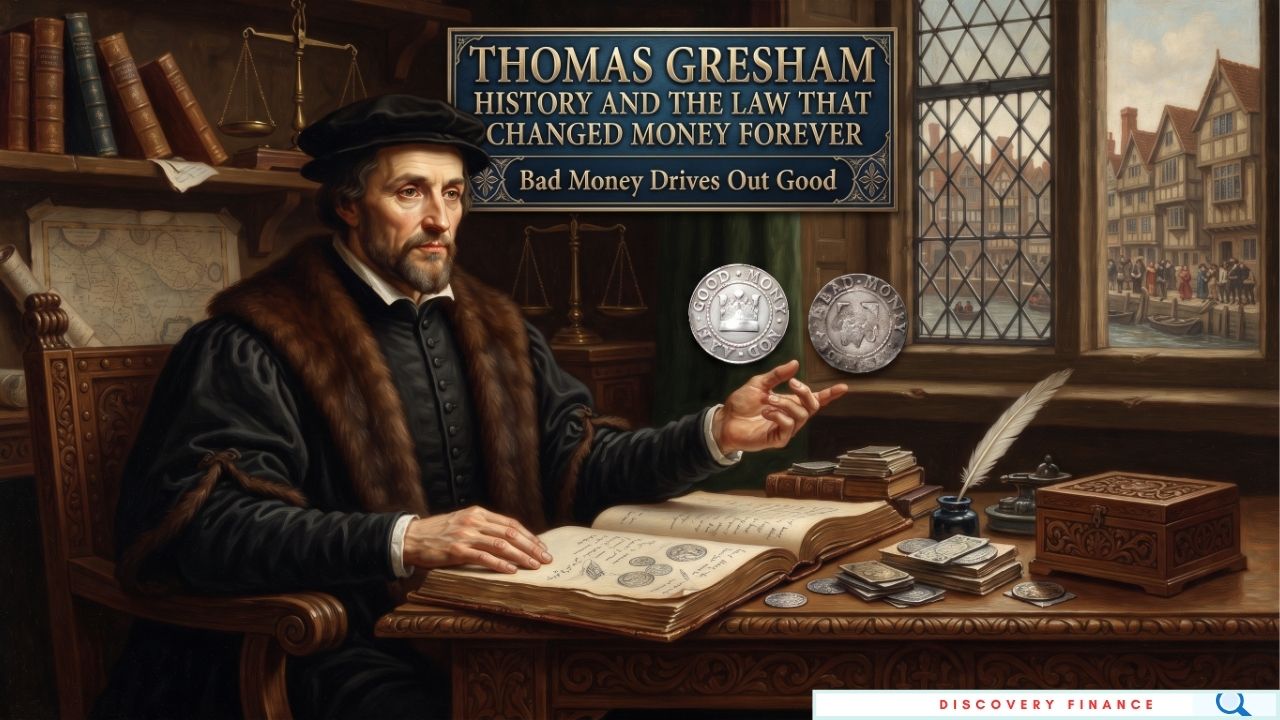
Uncovering the Roots of Thomas Gresham History
To truly appreciate Thomas Gresham History, we have to take a quick time trip back to 16th-century England under the Tudors. Sir Thomas Gresham was a brilliant merchant and financial agent serving Queen Elizabeth I. Back then, monarchs had a tricky habit of “debasing” currency—meaning they would mix cheaper, base metals like copper into gold and silver coins while keeping their official face value the same.
Gresham noticed something fascinating happening right under his nose: people would quietly hoard the pure, heavy coins (the “good money”) and spend the clipped, debased coins (the “bad money”) at local shops. It was a simple matter of self-preservation and logic. If you knew a coin had more real metal value tucked away in your drawer than what the store clerk was legally forced to accept it for, you were never going to part with it voluntarily.
Why “Bad Money Drives Out Good” Matters Today
Centuries later, economists coined the phrase “Gresham’s Law” to immortalize this concept: bad money drives out good money. When two forms of currency with the same face value but different intrinsic values circulate together, the inferior one takes over daily commerce while the superior one disappears into hiding.
Interestingly, this principle stretches far beyond old metal coins. Much like the hidden financial maneuvers uncovered when examining the mystery behind America’s most secretive billionaire, modern systems often reward clever optimization, sometimes forcing standard value out of sight. Whenever value is distorted by regulations or artificial pricing, human psychology reacts predictably—we hold onto what is genuinely precious and pass along what is cheap.
Final Thoughts: The Legacy of Thomas Gresham History
Looking back at Thomas Gresham History gives us a neat lens through which to view modern economics and personal finance. It reminds us that people respond dynamically to incentives, whether they are trading silver shillings in sixteenth-century London or managing digital portfolios today.
What’s your take on how modern currencies hold their value compared to the heavy metal coins of the past?
Share this:


You May Also Like

Tax Day 2026: Everything You Need To Know Before the April 15 Deadline

Yasuo Hamanaka Copper Scandal That Fooled Global Markets
