Harry Markowitz Modern Portfolio Theory That Transformed Investment Strategy
Have you ever opened up your brokerage app, looked at your balance, and felt like you were trying to balance on a tightrope during a sudden windstorm? You are definitely not alone. Trying to figure out the right mix of investments can feel like a stressful, high-stakes guessing game, but mastering the Harry Markowitz Modern Portfolio Theory completely removes the guesswork by providing an optimized frameworks for your long-term wealth. Building a balance, stable portfolio isn’t actually all that different from other cooperative lifestyle choices, like navigating the details of budgeting for couples: how to merge finances without the friction – both paths require you to stop looking at pieces in isolation, tune out short-term emotional swings, and build a unified strategy for sustainable growth.
When it comes to the stock market, older generations of investors used to pick stocks purely by looking at which individual company promised the highest return. But in 1952, a brilliant economist changed the game forever. He introduced a groundbreaking mathematical blueprint proving that you shouldn’t judge an investment by its standalone risk, rather by how it behaves in tandem with everything else you own.
Decoding the Core of Harry Markowitz Modern Portfolio Theory
To truly appreciate why the Harry Markowitz Modern Portfolio Theory completely flipped the financial world on its head, we have to look at the fundamental shift it created. Before Markowitz, if a stock was volatile, it was labeled “dangerous”. Markowitz proved that if you combined two volatile assets that move in opposite directions, their individuals swings cancel each other out, making the overall portfolio remarkably stable.
The theory relies on a few foundational pillars that form the roadmap for modern asset management:
- The Risk-Return Tradeoff: Investors are naturally risk-averse. To take on more volatility (measured as standard deviation), you must be compensated with a higher expected return.
- Diversification and Correlation: It isn’t enough to just own twenty different tech stocks if they all collapse at the exact same time during an economic downturn. true diversification means holding assets with low or negative correlation – like combing retail equities with bonds or tangible commodities.
- Mean-Variance Optimization: This is the quantitative process of calculating asset weights to get the cleanest balance between minimizing variance (risk) and maximizing the mean (expected return)
The Efficient Frontier: Finding Your Financial Sweet Spot
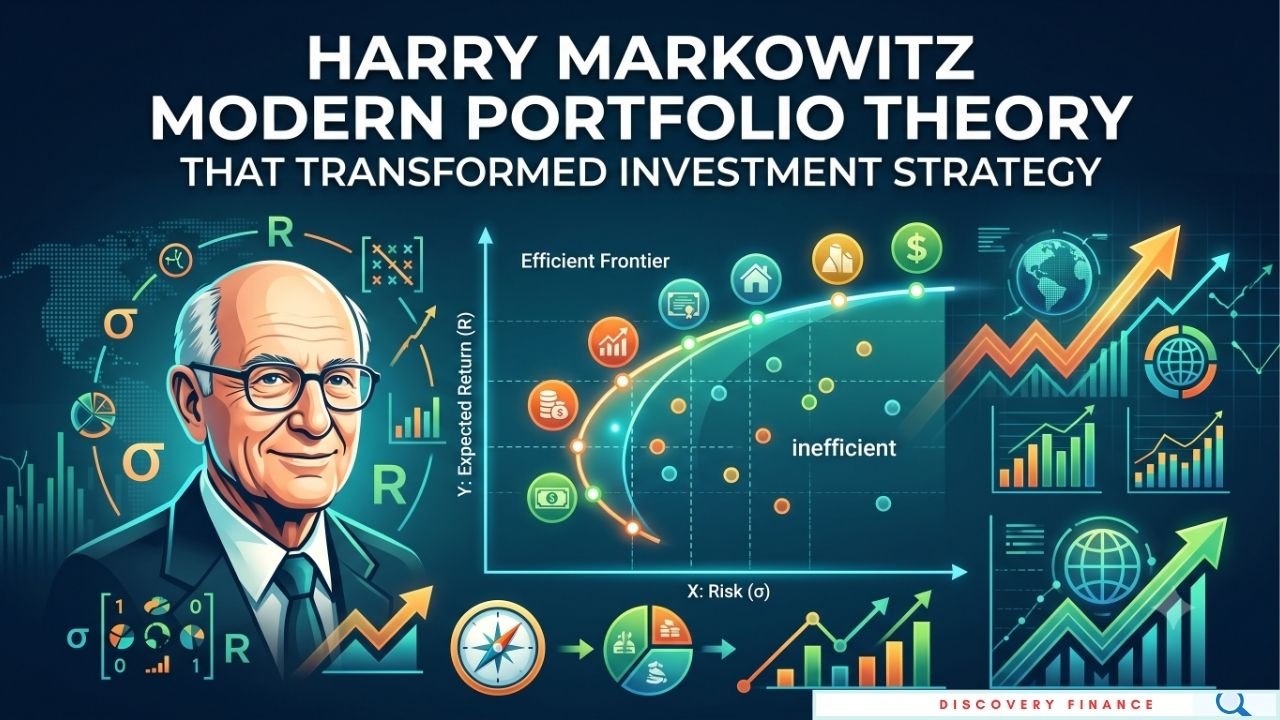
Under the Harry Markowitz Modern Portfolio Theory, there is no single “perfect” investment portfolio. Instead, there is a mathematical curve known as the Efficient Fronter.
Imagine a graph where the horizontal axis represents risk and the vertical axis represents expected return. The Efficient Frontier represents the absolute edge of that graph – the optimal boundary where you are getting the maximum possible return for a specific level of volatility, or conversely, the lowest possible risk for a targeted return. Any portfolio that falls below this curve is considered inefficient because you are leaving money on the table or taking on unnecessary stress for no extra reward. Where you decide to sit on that curve depends entirely on your personal risk tolerance and financial roadmap.
The Lasting Legacy of a Financial Revolution
Today, the principles established by the Harry Markowitz Modern Portfolio Theory serve as the bedrock for modern wealth building. His quantitative laid the initial groundwork that eventually allowed future innovators to build simple, accessible tools for everyday savers. Decades later, this mathematical blueprint directly inspired the John Bogle index fund revolution that changed investing forever, shifting trillions of dollars away from expensive, active stock-pickers and into low-cost, broadly diversified market index funds.
At the end of the day, looking back at the massive transformation brought on by Harry Markowitz reminds us that smart wealth building is a team sport for your assets. Take a close look at your own portfolio today. Are you betting heavily on a few isolated, highly volatile stocks, or are you anchored in a well-diversified, optimized foundation? Keep your head level, stay curious, and happy investing!
Share this:



2 Comments
Pingback:
Pingback: