Paul Tudor Jones Market Crash Prediction That Made Financial History
Have you ever looked at a crazy economic trend and thought, “There is no way this can last“? Whether it is trying to find clever strategic hacks to trim your monthly grocery budget against relentless inflation, or watching stock prices climb straight up into outer space, we all have moments where our intuition screams that a correction is coming. Most of the time, we hesitate to act on those gut feelings. But back in October 1987, one legendary trader turned his intuition and meticulous research into the Paul Tudor Jones Market Crash Prediction, a bold macroeconomic call that forever changed the landscape of modern financial research and made him an overnight Wall Street icon.
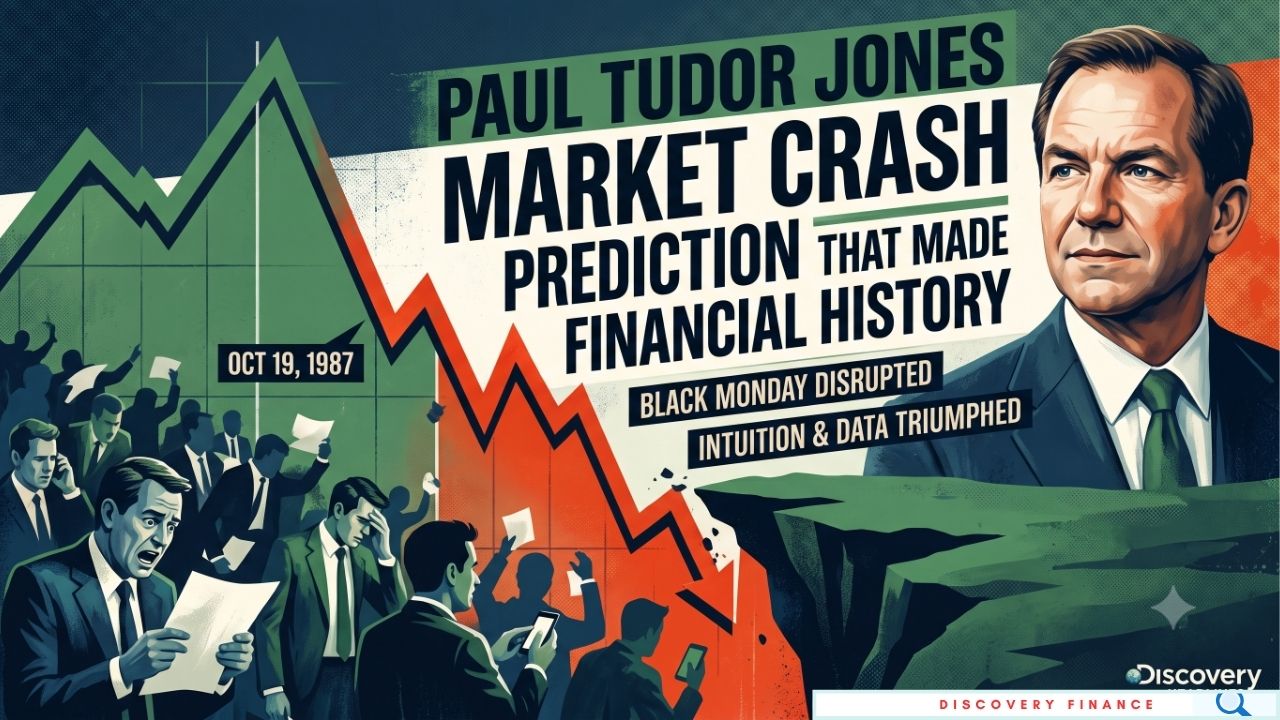
Inside the Paul Tudor Jones Market Crash Prediction
To truly understand the brilliance behind the Paul Tudor Jones Market Crash Prediction, we have to hop into a financial time machine and head back to the mid-1980s. The stock market was experiencing a parabolic bull run that felt completely unstoppable. Sound familiar? Between 1982 and the summer of 1987, the Dow Jones Industrial Average surged by over 200%. Valuations were stretched to the absolute limit, and everyday investors were completely blinded by fear of missing out (FOMO).
But while the crowd was busy celebrating, Paul Tudor Jones and his right-hand analyst, Peter Borish, were crunching the numbers in their cramped Manhattan office. They noticed something fascinating and deeply alarming: the chart of the 1987 stock market was tracking almost identically to the price action right before the devastating Wall Street crash of 1929.
Rather than shrugging it off as a historical coincidence, Jones trusted the data and aggressively shorted the market, betting big that a massive collapse was imminent. On Monday, October 19, 1987 – now infamously known as “Black Monday” – the floor dropped out. The Dow plummeted by a jaw-dropping 22.6% in a single day, marking the largest single-day percentage drop in financial history. While the rest of the trading world was in complete freefall, Jones’s hedge fund, Tudor Investment Corporation, locked in a mind-blowing 62% return for that month alone, eventually tripling their money by the end of the year and cementing his spot in the history books.
How History Challenged the “Perfect Market” Idea
What makes the Paul Tudor Jones Market Crash Prediction so fascinating isn’t just the sheer amount of money he made – estimated at over $100 million during the chaos – but how it fundamentally disrupted mainstream economic thought.
At the time, academia was heavily captured by the idea that markets are always perfectly rational and efficient. If you’ve spent any time reading up on institutional trading theories, you’ve likely crossed paths with the classic Eugene Fama efficient market theory that changed financial research forever. Fama’s hypothesis suggested that stock prices always reflect all available information, making it practically impossible to consistently beat the market or predict crashes through chart patters alone.
Yet, Paul Tudor Jones proved that human psychology, market structure imbalances, and raw momentum can cause prices to decouple completely from reality. He proved that the market isn’t a flawless, perfectly calculated machine; it is a living, breathing reflection of human emotion – oscillating between extreme greed and blind panic.
Paul Tudor Jones Market Crash Prediction
At the end of the day, the story of Black Monday reminds us to keep our heads level and always stay curious about what is happening beneath the surface of our financial lives. We don’t need a multi-billion-dollar macro hedge fund to benefit from Jones’s wisdom. The biggest takeaway from his historic trade is the vital importance of risk management, disciplined preparation, and having the courage to step away from the herd when things to look too good to be true.
The financial world will always have its ups and downs, but by staying grounded, protecting your capital, and focusing on variables you can actually control, you can navigate any market storm with absolute confidence. Happy investing!
Share this:





2 Comments
Pingback:
Pingback: